![]() |
| Picture from Wikipedia "Barnabas Collins" Page |
Sweet Goth (also known by Leslie) has a thing about vampires and other supernatural creatures and cemeteries.
Sunday, April 29, 2012
Sunday, March 25, 2012
Fresh Blood in Academia
Vampires want fresh blood. They want "new blood" to reinvigorate their hearts and allow them to continue their unchanging existence. They are not really interested in letting the new blood change them -- they only want to ingest it. Vampires are not interested in the post-use health of the donor.Sweet Goth (AKA Leslie) has been playing with the vampire metaphor as used by Kipling, and others, and has had an "ah ha!" moment concerning academia and their search for "Fresh Blood," or an endless supply of part-time marginalized instructors to be used until their blood is no longer new. (Read blood as innocence concerning the reason they are hired, enthusiasm for the department that hired them, and ignorance of the price they will pay... "Oh the years we waste and the tears we waste/ and the work of our head and our hands/ belong to the [person] who did not know why..."(Kipling).
Or as William Rex phrased it in his 1909 "Laborers" version of "The Vampire:"
A fool there was and he lived a slave
(Even as you or I)
To a master who drove him remourseless to grave
(And the master did not heed the wounds he gave)
-----
Oh the miseries he lived for the crumbs he received
And the kicks which a dog would abhor:
He took from the man who cared not to know why --
And now we know he never cared why)
And did not understand.
I think maybe we need to begin opening our hearts and our minds to "understand."
Monday, March 19, 2012
Kipling's "Vampire"
Sweet Goth (AKA Leslie) is working on a discussion of Kipling's poem, "The Vampire," for the American Popular Culture Conference in Boston (2012). Since I'll probably post about snippits surrounding the presentation, I feel it appropriate to post the poem here so that my readers will have some idea of what I'm on about.The picture at the right was painted by Phillip Burne-Jones the same year, and Kipling stated that it inspired his poem. Interestingly, some reviews of the painting consider Kipling's poem the only reason the painting became famous.
“The Vampire”
Rudyard Kipling : (1897)
A fool there was and he made his prayer
(Even as you or I!)
To a rag and a bone and a hank of hair,
(We called her the woman who did not care),
But the fool he called her his lady fair--
(Even as you or I!)
Oh, the years we waste and the tears we waste,
And the work of our head and hand
Belong to the woman who did not know
(And now we know that she never could know)
And did not understand!
A fool there was and his goods he spent,
(Even as you or I!)
Honour and faith and a sure intent
(And it wasn't the least what the lady meant),
But a fool must follow his natural bent
(Even as you or I!)
Oh, the toil we lost and the spoil we lost
And the excellent things we planned
Belong to the woman who didn't know why
(And now we know that she never knew why)
And did not understand!
The fool was stripped to his foolish hide,
(Even as you or I!)
Which she might have seen when she threw him aside--
(But it isn't on record the lady tried)
So some of him lived but the most of him died--
(Even as you or I!)
"And it isn't the shame and it isn't the blame
That stings like a white-hot brand--
It's coming to know that she never knew why
(Seeing, at last, she could never know why)
And never could understand!"
Monday, March 12, 2012
Sir Francis Varney, the Vampire

What happened when a vampire attempted to "pass" as a human back in Victorian times? Well, about the same things that would occur if anybody discovered that their nearest neighbor was an undead blood-sucking fiend who had broken into their home for an uninvited dinner off their sister.
Would they need proof? Well, when the Bannerworth's made their discovery, they needed none. They began proclaiming loudly to anyone nearby that Varney was a vampire. They knew he wasn't attractive, and he fit their idea of what a vampire would look like: pale, odd eyes, outdated clothing, and big white protruding teeth. He looked like a vampire, they named him a vampire, thus; he was a vampire. That was all the proof needed before polishing the stakes and checking the local crypts for possible post-human inhabitants.
For Varney, unfortunately, he really was a vampire. So when the rumors began to fly, he had to take to his heels as well, fleeing hordes of lower-class villagers who knew just how to take care of local vampires: cut their heads off and fill the mouths with garlic, impale them to the ground so they can't flee, burn them and scatter the ashes in running water. Effective treatment for slaying just about anything.
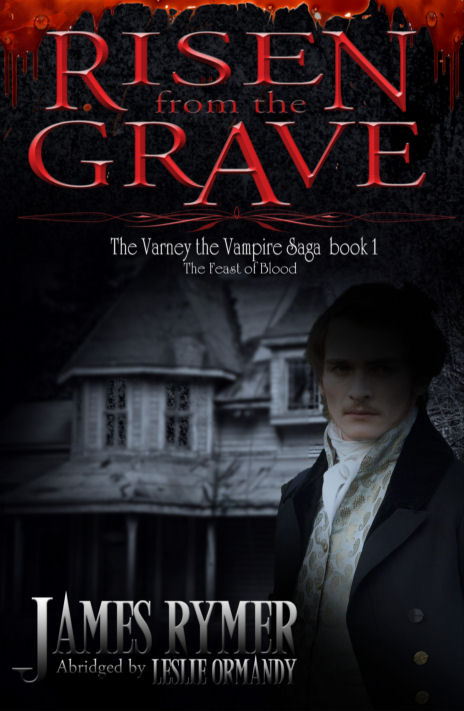
The Varney the Vampire Saga The Feast of Blood has been abridged and modernized from its original 20th century version, and is available on Kindle. for only $5.99 (Free for Prime Members).
Monday, March 5, 2012
Eternal Life Eternal Youth Eternal You

The problems do not appear in the disclaimer: You have to reinvent yourself constantly as fashions, social mores, and technology changes around you, and you don't physically change.
And you are yourself for all eternity. Can the dead change?
Think about it for awhile, and I will return to the conversation later. Meanwhile, a cup of blood.
Monday, February 27, 2012
Blood is the Life part 1
"The blood is the life" is both a biblical tenet, and a fact. Without blood rushing through our veins pumping oxygen into every cell of our body, our bodies stop. Full stop. Die. Bite the big one. We need pretty much every drop of blood we have safe inside our veins. Our blood is our life. So it behooves us to keep our blood firmly inside our own veins, right?Then donors go out and share it, donating it willy-nilly to blood-banks and vampires. Why do they do it? Well, in the case of donating to blood-banks it is quite normal and everyday. A kind effort at sharing from one human to another, and honestly, we can share some without ill effect. But donating life-blood to vampires, now that is the proverbial horse of a different color. Technicolor even. Why do it?
All the usual reasons, one suspects. A search for love and glory? A hope that quid pro quo will be in effect and one will eventually go from donor to donor-ee? The hope that sharing a bit of the good-stuff will satisfy the vampire and the donor gets to stay alive? The purely Samaritan impulse to be of help to someone in need -- even if they are no longer quite, well, living? But this is a kind impulse nonetheless. A combination of the reasons? The reasons will be different for each donor, as will the requests whispered by the vampire. The vampire will say, "save me."
It is human to attempt to save someone, anyone, who needs saving. Loosing that urge, arguably, means that one is becoming a bit less human. I believe strongly in free will, in personal choice, and the reasons to become a walking McMeal are personal. But remember, the blood is the life.
Thursday, February 23, 2012
Blood Brotherhood
In olden-times blood brotherhood was a staple of pirates and boy scouts (and girl scouts I might add.)
So "what is the relationship of blood-bothers to vampires," you might ask; and rightly so.
It seems to SweetGoth that this idea of blood merging two lives together is metaphorically similar to the idea of a vampire drinking my blood, and my life energy entering him/her/it and allowing him/her/it to "live." The relationship becomes stronger if one considers the methods most vampires use to propagate their species -- a blood exchange through which the vampire takes the life energy of the "victim" and in exchange joins the "victim" to the vampire's undead family, an eternal joining.
With his long talon-like nails he gnashed his wrist vein and then pressed it to my own which he had opened and fed from. As his blood merged with my own, I felt heat running up my arm though the large vein. I felt light-headed, and then the world went away. When I woke three days later, he was there waiting for me; his brother.