Tuesday, June 12, 2012

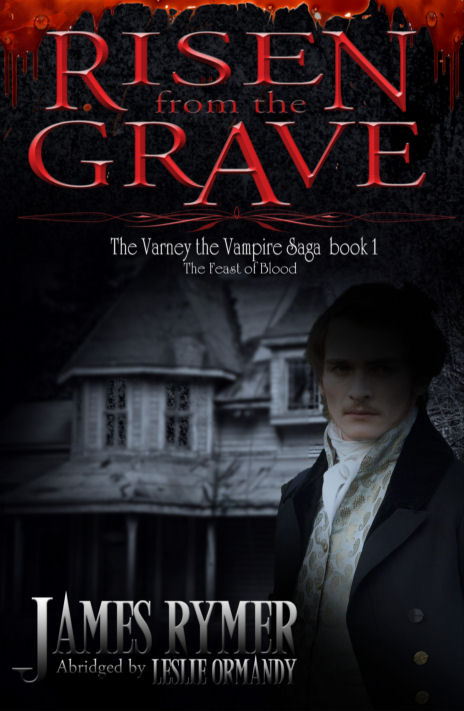
Risen from the Grave: a Heads-up

This week Sir Francis Varney emerged from the shadows he is more comfortable with and allowed Stacy Easton an interview. She has posted it on the World Literary Cafe website (here).

In the interview they discuss some of the reasons he began to change into a more romantic vampire,  He freely speaks out about the safety concerns any undead citizen must have when they are so misunderstood by the human society they hid within: mobs, staking, beheading, burning alive (all the usual...).

Sir Francis Varney also shares his opinion on where his biographers (James Rymer and Leslie Ormandy) went wrong when they told his tale. He allowed them some creative license, and in his opinion, they went too far.

Risen from the Grave: The Varney the Vampire Saga book 1; The Feast of Blood (here) is the first segment of Varney's story, totally revamped for a 21st century audience. This first of three projected tomes (tome = 519 pages, 391,000 words) is in its almost fully revamped form on Kindle. This version (cover tells different incarnation) differs from the "modernized" version in that the fully revamped combines the first two volumes (for a very long time there were five) into one and fully moves the novel into a more modern form.


Thursday, May 31, 2012

Image copyright Ormandy, Leslie 2003


As for me, let my bones and flesh be burned, and the ashes dropped in the moving waters, and if my name shall live at all, let it be found among Books, the only garden of forget-me-nots, the only human device for perpetuating  this personality. 
         Dr. Frank Crane (1919)


(Yes, I know this is a blog usually concerned only with vampires, but what of us who are not undead, who will not live eternally?)

Sunday, April 29, 2012

Picture from Wikipedia "Barnabas Collins" Page
At a conference recently, the conversation turned to a discussion of vampire fans. I have been thinking about the idea since then; asking myself the question: Is is creepy if I, and older female, ogle the young "vampire" characters trotting across my small screen?

 I remember when Dark Shadows arrived on our small black and white television (the picture was delivered in black and white for those of you who have never experienced it). All of us very young girls were "in love" with Barnabas Collins. He was the topic of lunch conversation, and the bane of teachers who had to endure the continued whispers about him in class. We giggled over him as he suffered the angst of having been made a vampire through a curse cast upon him; he did not choose to become one. He did not choose eternal blood-sucking, undead life.

For many of us, if not most, it was our first real experience with a vampire (discounting the vamping of Bella Lugosi's Dracula which was the stuff of Halloween costumes, and the vampires of Abbot and Costello).

Did you note above that I said that we were in love with Barnabas Collin? We KNEW that he was a character, an actor pretending to be a vampire. We were hot (well, as hot as elementary girls could be) about the character -- I doubt many of us were attracted to the actor himself. I will grant that given the age difference between a post-pubescent child and the actor, our fandom had elements of creep even when not considering that our real attraction was to the character of a couple-of-hundred year old vampire. But our gaze, our fan-mentality, saw the power and attraction of the character.

I am not sure, and this is true speculation and my thoughts are ongoing, but I have to wonder if the issue is less the age of the person gazing at the character (remembering that the actor playing Barnabas was Johnathan Frith who was certainly waaaayyyy older than much of his fanbase), and more about fans who fail to understand that the actor is not the character -- and then behave towards the actor inappropriately? Does "reality TV" have anything to do with our cultural loss of the separation of actor and character? And why shouldn't an older person enjoy the attractive vampire, such as Eric Northman, trotting across the screen? I think all these issues and questions need answering since they, in part, concern the sort of society we live inside of.

Sunday, March 25, 2012

Fresh Blood in Academia

Vampires want fresh blood. They want "new blood" to reinvigorate their hearts and allow them to continue their unchanging existence. They are not really interested in letting the new blood change them -- they only want to ingest it. Vampires are not interested in the post-use health of the donor.

Sweet Goth (AKA Leslie) has been playing with the vampire metaphor as used by Kipling, and others, and has had an "ah ha!" moment concerning academia and their search for "Fresh Blood," or an endless supply of part-time marginalized instructors to be used until their blood is no longer new. (Read blood as innocence concerning the reason they are hired, enthusiasm for the department that hired them, and ignorance of the price they will pay... "Oh the years we waste and the tears we waste/ and the work of our head and our hands/ belong to the [person] who did not know why..."(Kipling).

Or as William Rex phrased it in his 1909 "Laborers" version of "The Vampire:"

A fool there was and he lived a slave
(Even as you or I)
To a master who drove him remourseless to grave
(And the master did not heed the wounds he gave)

-----

Oh the miseries he lived for the crumbs he received
And the kicks which a dog would abhor:
He took from the man who cared not to know why --
And now we know he never cared why)
And did not understand.

I think maybe we need to begin opening our hearts and our minds to "understand."


Monday, March 19, 2012

Kipling's "Vampire"

Sweet Goth (AKA Leslie) is working on a discussion of Kipling's poem, "The Vampire," for the American Popular Culture Conference in Boston (2012). Since I'll probably post about snippits surrounding the presentation, I feel it appropriate to post the poem here so that my readers will have some idea of what I'm on about.

The picture at the right was painted by Phillip Burne-Jones the same year, and Kipling stated that it inspired his poem. Interestingly, some reviews of the painting consider Kipling's poem the only reason the painting became famous.

“The Vampire”

Rudyard Kipling : (1897)

A fool there was and he made his prayer

(Even as you or I!)

To a rag and a bone and a hank of hair,

(We called her the woman who did not care),

But the fool he called her his lady fair--

(Even as you or I!)


Oh, the years we waste and the tears we waste,

And the work of our head and hand

Belong to the woman who did not know

(And now we know that she never could know)

And did not understand!


A fool there was and his goods he spent,

(Even as you or I!)

Honour and faith and a sure intent

(And it wasn't the least what the lady meant),

But a fool must follow his natural bent

(Even as you or I!)


Oh, the toil we lost and the spoil we lost

And the excellent things we planned

Belong to the woman who didn't know why

(And now we know that she never knew why)

And did not understand!


The fool was stripped to his foolish hide,

(Even as you or I!)

Which she might have seen when she threw him aside--

(But it isn't on record the lady tried)

So some of him lived but the most of him died--

(Even as you or I!)


"And it isn't the shame and it isn't the blame

That stings like a white-hot brand--

It's coming to know that she never knew why

(Seeing, at last, she could never know why)

And never could understand!"


Monday, March 12, 2012

Sir Francis Varney, the Vampire


What happened when a vampire attempted to "pass" as a human back in Victorian times? Well, about the same things that would occur if anybody discovered that their nearest neighbor was an undead blood-sucking fiend who had broken into their home for an uninvited dinner off their sister.

Would they need proof? Well, when the Bannerworth's made their discovery, they needed none. They began proclaiming loudly to anyone nearby that Varney was a vampire. They knew he wasn't attractive, and he fit their idea of what a vampire would look like: pale, odd eyes, outdated clothing, and big white protruding teeth. He looked like a vampire, they named him a vampire, thus; he was a vampire. That was all the proof needed before polishing the stakes and checking the local crypts for possible post-human inhabitants.

For Varney, unfortunately, he really was a vampire. So when the rumors began to fly, he had to take to his heels as well, fleeing hordes of lower-class villagers who knew just how to take care of local vampires: cut their heads off and fill the mouths with garlic, impale them to the ground so they can't flee, burn them and scatter the ashes in running water. Effective treatment for slaying just about anything.

The Varney the Vampire Saga The Feast of Blood has been abridged and modernized from its original 20th century version, and is available on Kindle. for only $5.99 (Free for Prime Members).


Monday, March 5, 2012

Eternal Life Eternal Youth Eternal You


"Eternal life," he whispers into my ear, his breath a warm and honeyed moistness against the tender skin behind it. "You will never age," he continues softly as he presses his body into my back, rubbing his head against my own. "You will never die," he finishes as his lips dip to my neck and he nips it.

Such is the vampire promise. Eternal life. Eternal youth. What could be wrong with that? Honestly, in our youth obsessed culture, it sound pretty darn good.

The advertising is great. Usually it features a hot young thing offering eternal love and mind-blowing sex, at least in the paranormal romance field. It usually features companionship and willing blood-donors who are "special" in that they are allowed to know about vampires.

The package comes with super-powers also: super strength, enhanced senses, mesmerizing skills, ability to shape-shift and to heal from most wounds. It makes you more attractive since all the best predators are beautiful.

The problems do not appear in the disclaimer: You have to reinvent yourself constantly as fashions, social mores, and technology changes around you, and you don't physically change.

And you are yourself for all eternity. Can the dead change?

Think about it for awhile, and I will return to the conversation later. Meanwhile, a cup of blood.